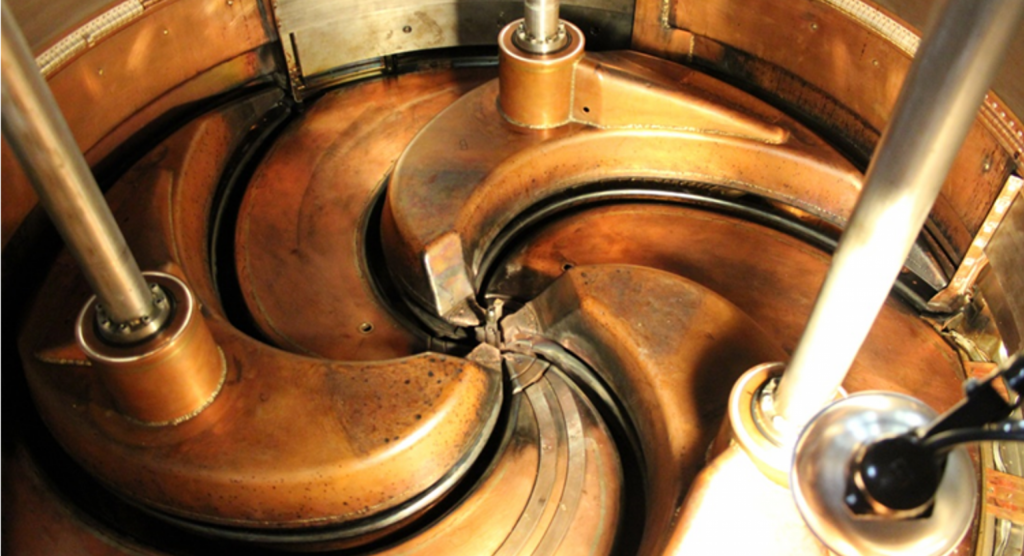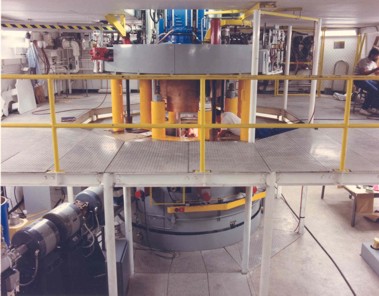
The K500 Cyclotron is capable of supplying a variety of ion beams to the experiments at the Cyclotron Institute. Starting from the ECR ion sources, ion beams of the very lightest elements to ion beams of the very heaviest of elements can be accelerated by the cyclotron to high energies. Beam energies for protons (ionized hydrogen) can range from 8 MeV to 70 MeV, while energies for uranium ions can range from 500 MeV (2 MeV per nucleon) to 3.5 GeV (15 MeV per nucleon).
At the heart of our cyclotron is a superconducting magnet whose intense magnetic field holds the ions in orbits between its poles. The 50 kilogauss magnetic field is generated by 800 amperes of electrical current carried by 5500 turns (25 miles) of niobium-titanium superconducting wire in a coil surrounded by 100 tons of steel. The acceleration of the ions is accomplished by intense, rapidly alternating electric fields generated by a 240-kilowatt radio-frequency system and impressed upon hollow copper structures called dees located between the poles of the magnet. The generation, injection, acceleration and delivery to target of the ions takes place in high vacuum, while the path and focus of the beam outside the cyclotron is controlled by high-field, electromagnets.